
Date: 28 September 2025
The Foundational Axioms, Universal Equation, and Master Table of the Unified Resonance Model (URM 0) are released under CC BY 4.0. This is a living framework: refinement and falsification are expected as part of the model’s development.
Executive Overview
Physics has long been split in two: quantum mechanics (probabilities, discreteness, flicker) and classical mechanics/relativity (continuity, determinism, smooth fields). Both regimes work operationally, but they don’t explain why the universe has to show up in two apparently incompatible ways.
We propose that the true root is Apparency: the universe is not “things” but appearances (A-states) of constraint and release. Everything we call energy, inertia, momentum, spin, and time are simply different appearances of the same process.
This leads to the Standard Glob — the fundamental unit of reality. Each glob evolves through three natural bands (inertia, momentum, inverted inertia), forming a Möbius loop called the Arc of Resistance. Spin is the torsion of this arc; time is its flicker.
Quantum and classical physics then become two ways A-states are expressed: fast flicker (quantum, lassoed as discrete) vs. slow coherence (classical, appearing continuous).
This model is falsifiable: it predicts precise proportionalities between time compression, inertial resistance, and spin flicker.
⸻
1. Apparency as the First Fundamental
At root, reality is binary: Does it show? Apparency = Yes (1) or No (0). This is the universe’s primordial qubit.
From this binary seed:
• E = 1 → Energy is the affirmation of apparency.
• E = E → Energy is self-identical; it doesn’t require an external cause.
• A = A → Apparency grounds itself.
• E = I → Energy = inertia = constraint expressed.
👉 All physics begins not with numbers, but with apparency states (A-states).
⸻
2. The Standard Glob and the Arc of Resistance
Every coherent entity is a glob: a phase-bounded bundle of apparency. Each glob evolves through three bands:
1. Inertia (Stick) → resistance dominates; energy held as internal constraint.
2. Momentum (Slip/Slide) → constraint partially released; motion expressed.
3. Inverted Inertia (Stick’) → momentum folds back into resistance; constraint saturates toward Planck.
This Möbius loop is the Arc of Resistance.
• Spin = the torsional twist of the arc (why fermions need 720° to return).
• Time = the flicker of the arc’s torsion (local, non-universal).
• Energy = the appearance of constraint shifting between bands.
⸻
3. Quantum and Classical Bound in A-States
• Classical physics: A-states stable → appear as continuous motion and fields.
• Quantum physics: A-states flicker fast → observer’s lasso frequency locks a discrete outcome (spin up/down, photon absorbed/emitted).
• Both are simply different bands of apparency in the Standard Glob.
So quantum and classical are not separate realms — they are one continuum of A-states.
⸻
4. Constraint and Release
• At Planck density, all is constraint (pure inertia).
• Light: unconstrained apparency → propagation at c.
• Matter: partially constrained → inertia and momentum alternating.
• Black holes: constraint cannot be shed → glob saturates; resistance = density = time halt.
Energy is not a “thing” moving around but the apparent state change of constraint releasing or returning.
⸻
5. Mathematics (Numbers vs. Globs)
Number case:
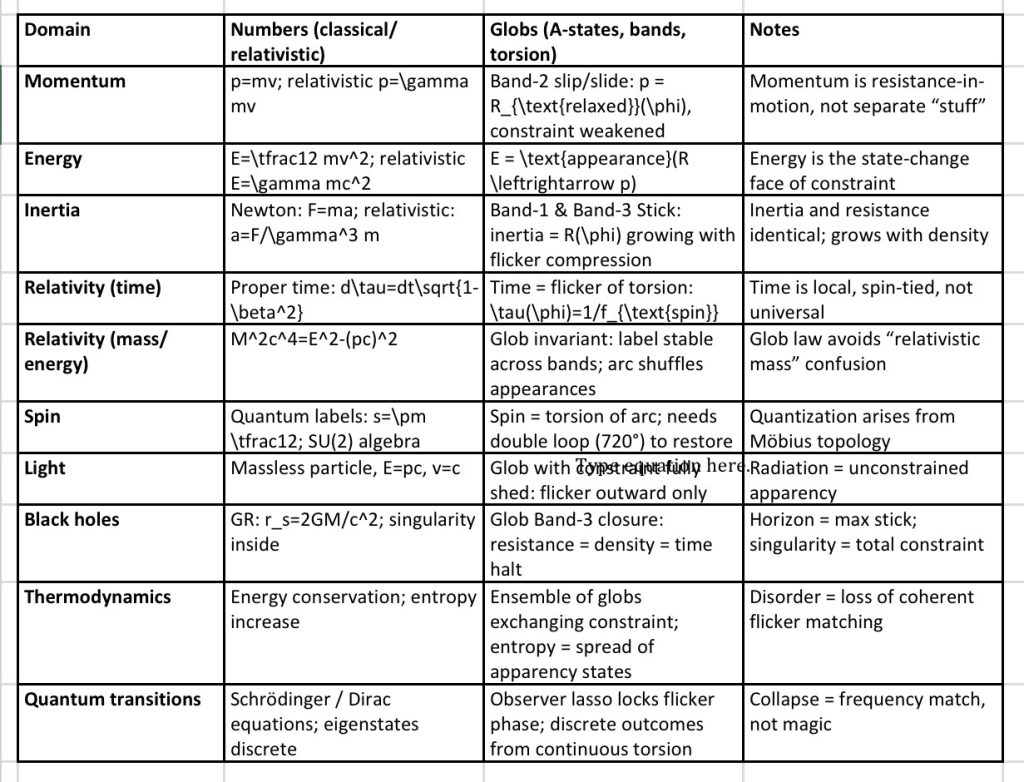
p=mv, \quad E=\tfrac12 mv^2, \quad p=\gamma mv, \quad E=\gamma mc^2
Patches required; paradox of infinite momentum vs capped velocity.
Glob case:
No paradox: momentum loops back into inertia.
$$
\mathrm{Arc\ of\ Resistance:}\; R \to p \to R^{\prime}
$$
$$
\mathrm{Spin}= \mathrm{torsion\ of\ arc}, \qquad
\mathrm{Time}= \mathrm{flicker\ of\ torsion}.
$$
No paradox: momentum loops back into inertia.
DSL snippet:
GLOB Standard:
BAND1: Stick -> inertia
BAND2: Slip -> momentum
BAND3: Stick’-> inverted inertia
LOOP: Stick -> Slip -> Stick’
Spin = torsion(Arc)
Time = flicker(Spin)
Energy= appearance(Constraint state)
⸻
6. Experimental Anchors
• Relativistic electrons: momentum growth and time dilation follow the same γ-curve → resistance vs time compression proportional.
• Atomic clocks: each clock’s tick = spin flicker of a glob → time is local, not universal.
• Black holes: horizon = Band 3 closure: resistance infinite, flicker zero.
⸻
7. Falsifiability
• Prediction 1: Resistance growth and time compression are locked by the same factor (\gamma).
• Prediction 2: Spin quantization observable as torsion of the resistance arc, not arbitrary algebra.
• Prediction 3: Constraint-release thresholds (light vs black hole formation) define experimental boundaries.
Failure to see these proportionalities would falsify the model.
⸻
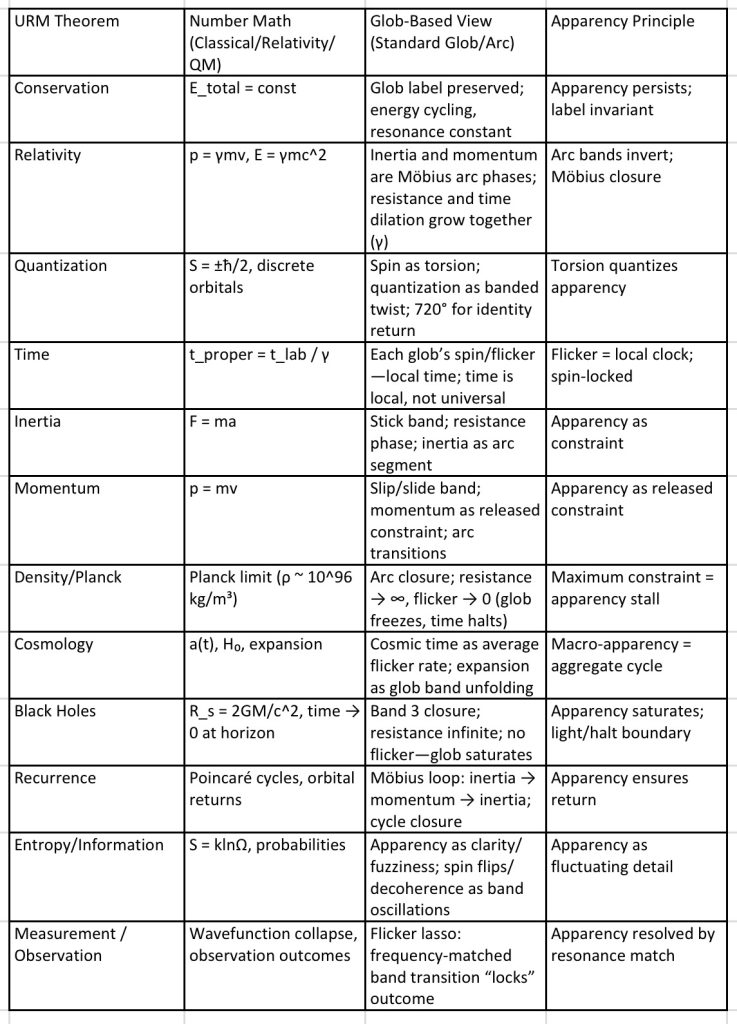
8. Mapping to the 12 Basic Theorems
(see full table in Appendix)
• Conservation: glob label invariant, appearances shuffle internally.
• Inertia/Momentum: the Arc of Resistance.
• Spin/Time: torsion + flicker.
• Density/Resistance: identical at Planck.
• Cosmology: cosmic time = average flicker of globs.
• Recurrence: Möbius loop ensures return.
⸻
9. Comparative Sidebar
• Relational QM: emphasizes observer-dependence, but not structural banding.
• Information Field Theory: models fields as informational, but lacks falsifiable density–time link.
• Wolfram’s Physics Project: cellular rules, but no intrinsic mapping of spin/time to torsion/flicker.
• URM/Globs: unique in providing continuous structure, falsifiable curves, and band unity.
⸻
10. Summary
The universe is apparency: Yes/No qubits of constraint and release. From that seed arises the Standard Glob, evolving through inertia, momentum, and inverted inertia. Spin is torsion, time is flicker, energy is appearance.
Quantum and classical physics are unified as different bands of the same A-states. Falsifiability is built in: resistance and time compression are proportional, spin torsion measurable, black holes and light are the two end-points of constraint.
This is not patchwork — it is the closure of physics under apparency as first fundamental.
11. Table: Core Formulas — Numbers vs. Globs (Apparency States)
12. Theorem Mapping: From Numbers to Globs
Highlights
• Numbers use \gamma and patchwork formulas.
• Globs use constraint → release → torsion → flicker as continuous variables.
• Every major formula has a glob analogue in A-states.
• Falsifiability: proportionality of resistance growth & time compression (\gamma), spin torsion as observable structure, Planck boundary as max stick.
Foundational Physics
- Einstein, A. Zur Elektrodynamik bewegter Körper. Annalen der Physik (1905).
- Einstein, A. Does the Inertia of a Body Depend Upon Its Energy Content? (1905) — original E=mc^2 note.
- Feynman, R. Lectures on Physics, Vol. I–III (1964).
- Misner, Thorne & Wheeler. Gravitation. (1973).
Relativity, Inertia, Momentum, Time
- Taylor, E.F. & Wheeler, J.A. Spacetime Physics. (1966, updated 1992).
- Rindler, W. Introduction to Special Relativity. (1991).
- Greene, B. The Fabric of the Cosmos. (2004).
- Time dilation experiments: Hafele, J. & Keating, R. Around-the-World Atomic Clocks: Predicted Relativistic Time Gains. Science (1972).
Quantum Spin & Measurement
- Dirac, P.A.M. The Principles of Quantum Mechanics. (1930).
- Sakurai, J. Modern Quantum Mechanics. (1994).
- Penrose, R. The Road to Reality. (2004).
- Aspect, A. Bell’s Theorem Tests and Quantum Nonlocality. Physics Today (2004).
- On spinors and 720° property: Cartan, É. The Theory of Spinors. (1937).
Black Holes, Planck Scale, Density
- Hawking, S.W. Black Hole Explosions? Nature (1974).
- Bekenstein, J.D. Black Holes and Entropy. Phys. Rev. D (1973).
- Wald, R. General Relativity. (1984).
- Rovelli, C. Planck Stars and Quantum Gravity. (2014).
Cosmology & Time
- Hubble, E. A Relation Between Distance and Radial Velocity Among Extra-Galactic Nebulae. PNAS (1929).
- Perlmutter, S. et al. Measurements of Ω and Λ from 42 High-Redshift Supernovae. ApJ (1999).
- Tegmark, M. Parallel Universes. Scientific American (2003).
Information, Apparency, Foundational Debates
- Wheeler, J.A. Information, Physics, Quantum: The Search for Links. (1989).
- Rovelli, C. Relational Quantum Mechanics. Int. J. Theor. Phys. (1996).
- Hossenfelder, S. Backreaction: Reasoning in Physics. Blog (2016).
- Wolfram, S. Finally We May Have a Path to the Fundamental Theory of Physics. (2020).
Recent & Supporting Work
- “Charting GLOBs in Asymptotically Safe Gravity.” arXiv:2509.14309v1 (2025).
- ScitechDaily. Rewriting Physics Textbooks: Scientists Propose a Bold New Theory About the Universe’s Origins. (2024).
- “Physics in the Real Universe: Time and Spacetime.” arXiv:gr-qc/0605049 (2006).
- Information Field Theory: Enßlin, T.A. Information Field Theory for Cosmological Structures. Annalen der Physik (2013).